
The Death of the Résumé? How AI and Skills-Based Hiring Are Changing Recruiting in 2027
Every year someone declares the résumé dead, and every year recruiters keep asking for one. Heading into 2027, though, two forces are squeezing it from both sides. Candidates are using AI to write and send applications at a scale recruiters can’t read, and employers are using AI agents and skills-based hiring to look past the document altogether.
The résumé isn’t gone. But its job has changed, from the main thing you judge a candidate on to one input among several. Here’s what the data says, and what it means for recruiters planning their 2027 process.
The application flood broke the résumé as a signal
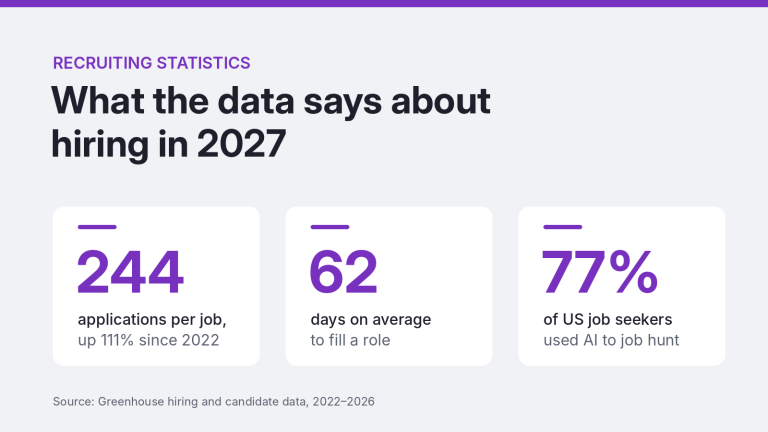
The problem starts with volume. In 2026, Greenhouse reported an average of 254 applicants per job posting across roughly 175,000 live jobs, and a 412% rise in applications per recruiter. Recruiting teams have not grown to match.
Much of that growth comes from AI writing tools and auto-apply bots that let a candidate send hundreds of tailored-looking applications a day. The Willo Hiring Trends Report 2026 found that 77% of hiring teams regularly see AI-generated or AI-assisted applications, up from 53% in early 2024. A Robert Half survey of more than 2,000 hiring managers found that 67% say AI-generated résumés have made hiring slower.
When every résumé is polished and matched to the job description, polish stops telling you anything. That is the real “death” of the résumé: not that it disappears, but that it no longer separates strong candidates from everyone else.
Skills-based hiring: widely claimed, unevenly practiced
The obvious alternative is to judge candidates on what they can do. Employers say they’re doing exactly that. In the National Association of Colleges and Employers’ Job Outlook 2026 survey, 70% of employers said they use skills-based hiring for entry-level roles, up from 65% a year earlier, and TestGorilla’s research found 53% of employers had removed degree requirements from at least some postings (Forbes has a good summary of both).
The hiring data tells a more modest story. A study by Harvard Business School and the Burning Glass Institute looked at what happened after large companies dropped degree requirements. Around 45% changed their job ads but not their hiring, and at some firms fewer than 1 in 700 new hires came from candidates without a degree. Only about 37% of the companies, the “skills-based hiring leaders”, meaningfully increased their share of non-degree hires.
The gap is usually in the process, not the policy. Removing “bachelor’s degree required” from a posting changes nothing if recruiters and hiring managers still screen résumés for the same schools and job titles.
Agentic AI: more plans than deployments
The other force is AI that does more than draft a job ad. Agentic recruiting tools can source candidates, send outreach, screen replies and book interviews with limited supervision. Korn Ferry’s 2026 Talent Acquisition Trends survey of 1,674 talent leaders found 52% planned to add autonomous AI agents to their recruiting teams during the year.
Actual use is far lower. Josh Bersin’s research in mid-2026 put the share of frontline employers using agentic recruiting tools at under 5%, and Bullhorn’s GRID 2026 survey found that while 30% of staffing firms use some agentic tools, only 10% have them embedded across their whole workflow.
So for most teams in 2027, AI will handle defined steps such as screening, scheduling and first-round questions, rather than running hiring end to end. That is still a big change for the résumé, because the first “reader” of an application is increasingly software.
What replaces the résumé as the main signal
The teams getting better results are adding evidence that is harder to fake with a chatbot:
- Short skills assessments early in the process. A work sample or job-relevant test tells you more than a keyword match. Keep it short, so strong candidates with other options don’t drop out.
- Structured screening questions. Two or three role-specific questions, scored against a rubric, filter faster than reading résumés. Recruiting chatbots can ask them at scale, especially for hourly roles.
- Asynchronous video for first rounds. One-way interviews let candidates show how they think and communicate, and let hiring managers review on their own time. See our guide to video interview software.
- Better job ads. Clear must-have skills and a pay range, which many states now require anyway, discourage mass applications from people who aren’t a fit.
- Referrals and talent pools. People you already know, including past applicants and former employees, come with signal a cold application lacks.
The résumé still earns its place later in the process: it gives interviewers a career history to ask about and a record to check claims against.
What recruiters should do before 2027
- Decide what the résumé is for. If it’s no longer your main screen, say so in your process and train hiring managers to judge assessments and structured answers instead.
- Define skills per role. Write down the four or five skills that predict success, and how you’ll test each one. Without this, “skills-based” is just a label.
- Measure who you actually hire. Track the share of hires without a degree or from non-traditional backgrounds. That’s the number that shows whether a policy change worked.
- Automate the repetitive steps first. Screening, scheduling and status updates are where AI saves time today. Look at your applicant tracking system before buying a separate tool; many now include these features. For high application volumes, see our guide to high-volume hiring software.
- Keep a person on every rejection decision that matters. AI screening tools can repeat bias, and several US states and cities now regulate them. A human review step protects candidates and you.
- Watch candidate experience. If your process takes longer because of extra steps, explain why and keep the total time reasonable. Good candidates still have choices.
Frequently asked questions
Is the résumé really dead?
No. Most employers still ask for one, and it remains useful for interviews and background checks. What has faded is its value as the first screen, because AI tools make most applications look equally polished.
What is skills-based hiring?
It means judging candidates on demonstrated skills, through assessments, work samples or structured questions, rather than on degrees, job titles or where they worked before.
Are companies actually dropping degree requirements?
Many have dropped them from job ads, but far fewer have changed who they hire. Research from Harvard Business School and the Burning Glass Institute found that roughly 45% of firms that removed requirements made no real difference to their hiring.
What is agentic AI in recruiting?
It refers to AI systems that carry out a sequence of recruiting tasks, such as sourcing, outreach, screening and scheduling, with limited human input, rather than helping with a single task. Many talent leaders plan to adopt it, but few use it across the whole hiring process yet.
How should candidates respond?
Apply to fewer roles with more care, make specific achievements easy to verify, and expect to show skills directly through tests or work samples.