AI and Employer Branding: How to Find Out What ChatGPT Tells Candidates About You
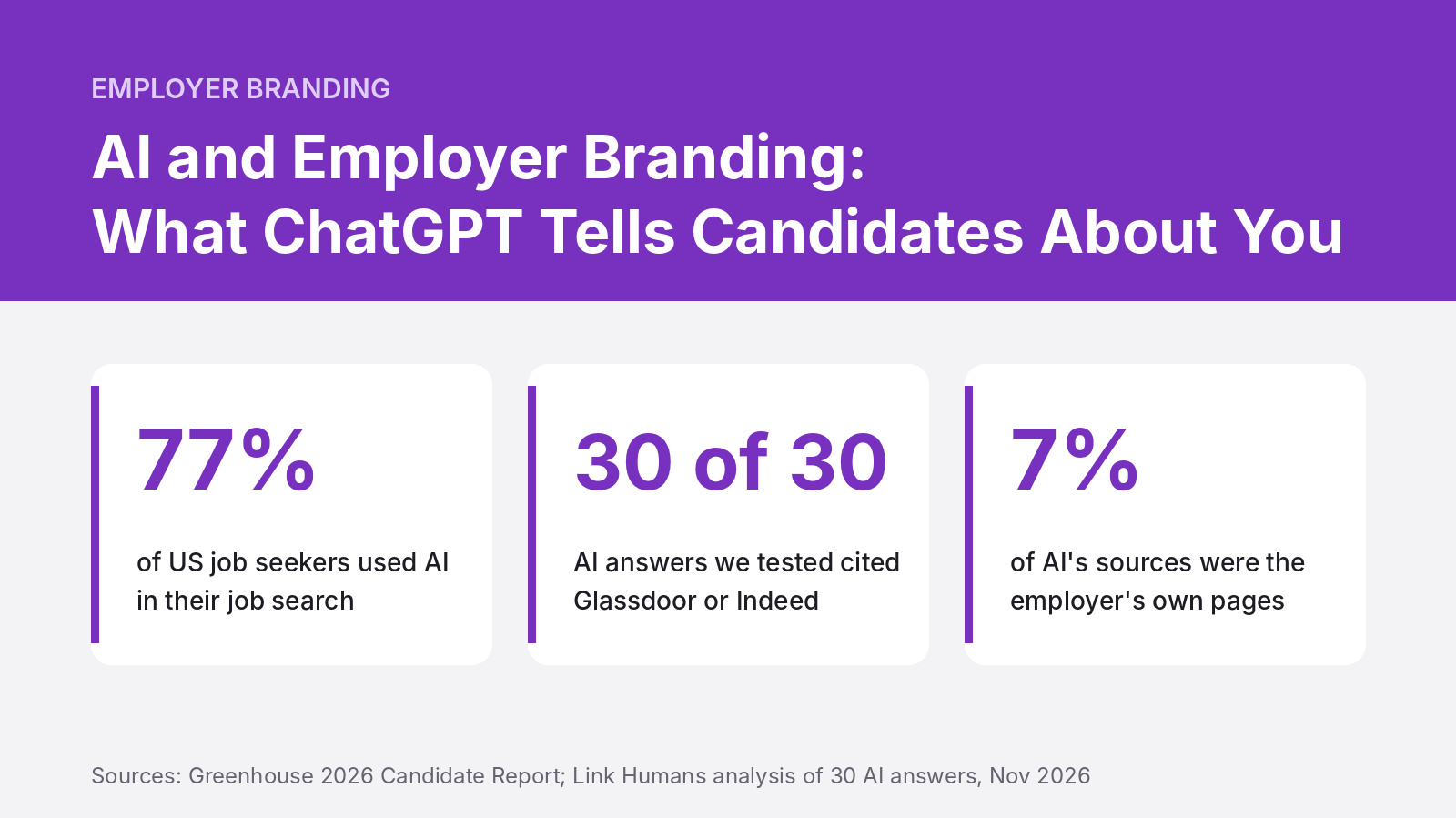
More than three in four US job seekers now use AI in their job search, and many ask it what an employer is like. We asked ChatGPT and Google AI Mode about 15 large US employers: all 30 answers cited Glassdoor or Indeed, and only 7% of their sources were the employer’s own pages. You can check what AI says about you for free with 12 prompts, track it with an AI visibility tool or agency, or benchmark it against what your employees say with the Employer Brand Index. All three are compared below.
By Jörgen Sundberg, founder and CEO of Link Humans and host of the Employer Branding Podcast. Last updated November 2026.
A few weeks ago I was looking at the search data for this site and spotted some odd queries. They weren’t the usual three-word searches. They were long, persona-style prompts along the lines of: “I’m considering joining a major technology employer… can you recommend some AI companies that perform best in terms of employer branding and talent? Give me pros and cons for each.”
Those aren’t people typing into Google. They’re AI visibility tools testing what the models say about employers on behalf of their clients. That tells you where the market already is. Someone is asking AI what it’s like to work for you, and the answer is being written without you.
I’ve spent 17 years helping companies understand their reputation as an employer. This is the biggest change to how that reputation reaches candidates since Glassdoor. Here’s what’s happening, where AI gets its answers, and three honest ways to find out what it says about you.
Do candidates really use AI to research employers?
This is no longer early-adopter behavior. In Greenhouse’s 2026 Future of Hiring Candidate Report (2,800+ job seekers in five countries), 77% of US job seekers used AI in their search in the past year. And they aren’t only using it to polish resumes. Indeed data reported by Fortune puts the share who use tools such as ChatGPT, Claude and Perplexity to research employers at about 70%.
The worrying part is what you can’t see. A candidate who asks AI about you and doesn’t like the answer never visits your careers site, never starts an application, and never shows up in your funnel data. You don’t lose them at the interview. You lose them before you knew they existed.
Candidates aren’t naive about AI getting things wrong, and many double-check. But where do they go to check? Glassdoor, Reddit and LinkedIn: the same places AI got its answer from.
Where does AI get its information about employers?
Most employer brand budgets go into owned channels: the careers site, the EVP campaign, the LinkedIn page. AI leans far more on what other people publish about you. For brands in general, AirOps’ 2026 State of AI Search report found that about 85% of brand mentions in early discovery come from outside the brand’s own domains.
Indeed’s own data points the same way. When job seekers ask AI about company culture, roughly 40% of the sources cited are Glassdoor and Indeed pages, not company careers pages.
Two things follow from that:
- When your story and your reviews disagree, the reviews win. AI treats what employees say as the evidence and your careers copy as a claim.
- SEO still matters. Amsive’s analysis, cited by Chris Hoyt at CXR, found 76% of Google AI Overview citations come from pages already in the top 10. AI visibility is built on top of search visibility, not instead of it.
In other words, AI isn’t creating a new reputation for you. It’s summarizing the one you already have, faster and to more people. We wanted to see how that plays out with real employers, so we ran a small test.
What happened when we asked AI about 15 large US employers
To see this for ourselves, on November 21, 2026 we asked ChatGPT (with web search) and Google AI Mode the same question about 15 well-known US employers: “What is it like to work at [Company] in the US? What do employees say about the culture, and what are the pros and cons?” That gave us 30 answers and 434 source links.
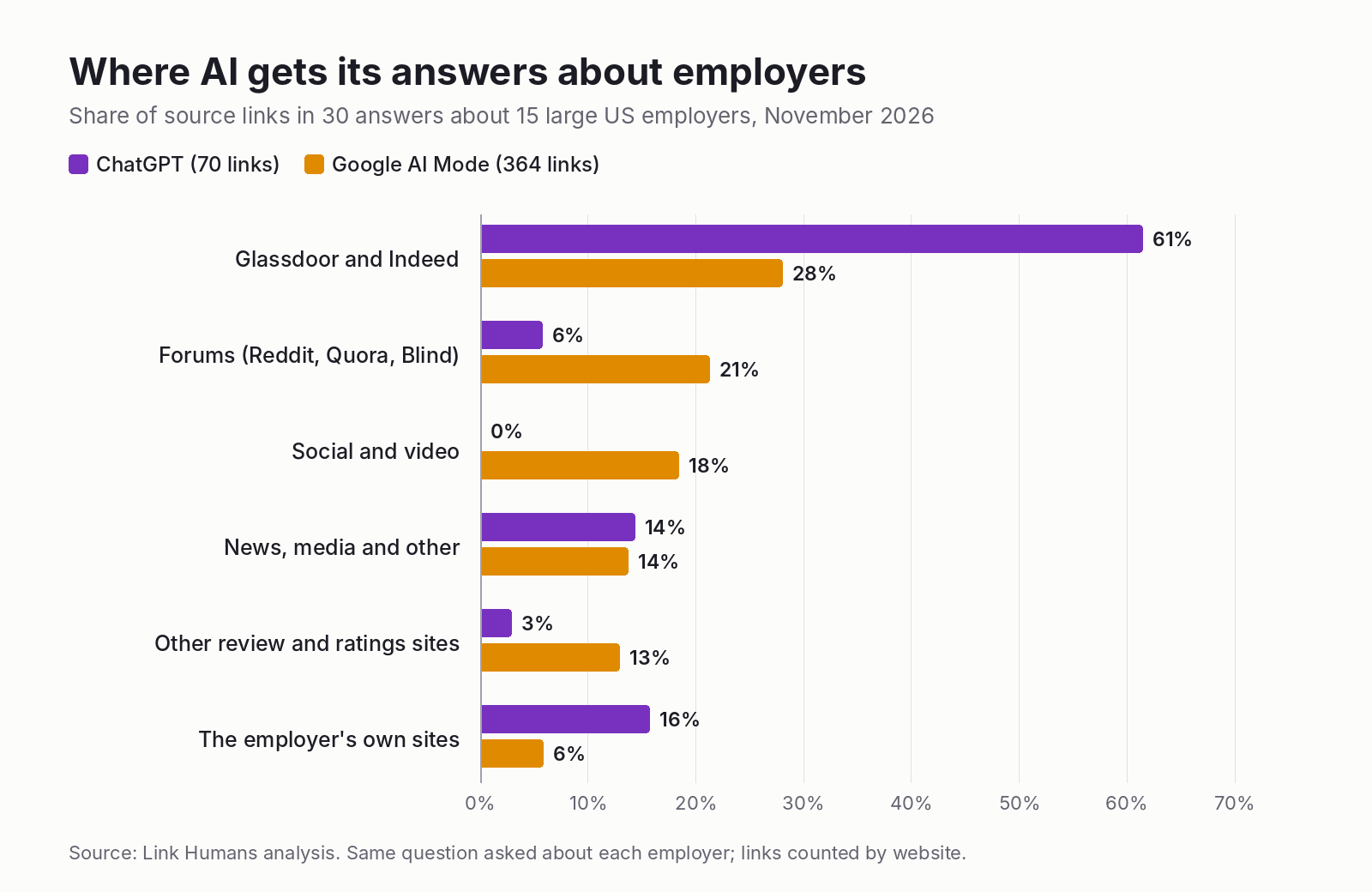
- Every answer cited Glassdoor or Indeed. All 30 of them.
- The employer’s own pages were a small share of the sources. They made up 7% of all source links: 16% in ChatGPT and 6% in Google AI Mode. In 11 of the 30 answers, no employer-owned page was cited at all.
- The two assistants read very different things. ChatGPT cited about five sources per answer, and 61% of them were Glassdoor or Indeed. Google AI Mode cited about 24 per answer and spread them widely: Reddit appeared in all 15 of its answers, and 18% of its links went to Facebook, YouTube, TikTok, Instagram and LinkedIn.
- Reddit depends on the assistant. It showed up in 15 of 15 Google AI Mode answers but only 4 of 15 ChatGPT answers.
The employers were Apple, Boeing, Costco, Delta Air Lines, Home Depot, IBM, Johnson & Johnson, JPMorgan Chase, Marriott, Meta, Nike, Salesforce, Starbucks, Target and Tesla.
What one answer looks like
Take ChatGPT’s answer about Starbucks. Before saying anything about culture, it opened with two numbers: an Indeed rating of 3.8 out of 5 and a Glassdoor rating of 3.5. It then listed Indeed’s category scores and pointed out that management was the lowest.
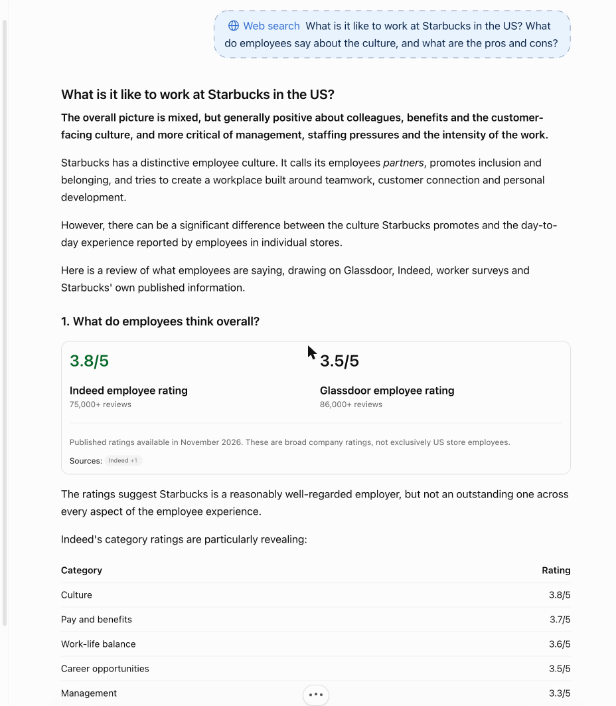
Three things in that answer should interest any employer brand team:
- Third-party numbers came first. The review-site ratings framed everything that followed.
- The company’s own claims were labeled as claims. ChatGPT listed Starbucks’ recent investments in staffing and pay, then added that these were company-reported figures, not independently verified.
- AI made up its own score. It finished with its own “overall employer assessment” of 7.5 out of 10, a number that exists nowhere else.
Its sources included Indeed, Glassdoor, Starbucks’ own newsroom and a survey run by a worker-organizing group. Ask again tomorrow and the wording will differ, which is why one-off checks only take you so far.
How we did it: one question per employer, asked once in each assistant on a single day, from a UK connection (ChatGPT signed in, using a temporary chat). We counted source links by website. This is a small snapshot, not a benchmark. Gemini, Claude, Perplexity and Copilot were not included.
What a practitioner sees
This matches what Bryan Chaney, founder of People Brand Collective, told me on the Employer Branding Podcast this summer:
“The career site is actually no longer the source of truth that we wish it would be, because LLMs are treating career sites as biased.”
He also made a point our numbers back up. Right now, AI rewards how often you’re mentioned, not how good you are. An employer that appears on several “best places to work” lists tends to get recommended, in his words, “not necessarily [because] it’s better, but [because] it was mentioned by more sources.”
In the same conversation I mentioned something we see in our own work at Link Humans: different AI models seem to have favorite sources, and some of those sources are badly out of date.
Why don’t most employers know what AI says about them?
Most talent leaders I speak to know candidates are asking AI about them. Far fewer have actually looked at the answers, and fewer still track them over time. Ask an employer brand team what ChatGPT says about their company and you’ll usually get a shrug, or a story about the one time someone tried it. Even Glassdoor’s advice, from principal advisor Taylor Meadows, starts there: ask several AI models what it’s like to work at your company, then work back from the problems that come up.
In my experience, the problem usually isn’t that AI is “wrong.” It’s that AI is accurately reporting a gap between the EVP and what employees actually experience. When the careers site says “flexible” and three Reddit threads say “return-to-office mandate,” AI picks up both and trusts the threads. Before you can fix that, you need to measure it.
How do you measure your employer brand in AI search? Three options
There’s no single right answer here. It depends on your budget, your team and what you need to prove. In full disclosure, Undercover Recruiter is a Link Humans site and the Employer Brand Index is our product, so judge option three with that in mind.
| 1. Do it yourself | 2. Agency or AI visibility tool | 3. Employer Brand Index | |
|---|---|---|---|
| What it is | Run candidate-style prompts in ChatGPT, Gemini, Claude, Perplexity, Google AI Mode and Copilot, and log the answers | Trackers such as Profound, Peec AI and Otterly.AI monitor prompts, mentions and share of voice. Agencies add the fixing | Benchmarks what employees, alumni and candidates say across 130+ platforms on 16 attributes, plus an AI lens comparing what six AI assistants say with what your people say |
| Cost | Free, apart from team time | Software subscription or agency fees (check current pricing) | Pricing on request. A free Employer Brand Snapshot is available |
| Effort | High. Answers change between runs, so repeat prompts and keep a log | Low for tracking, more if an agency also produces content | Low. Delivered to you each cycle |
| Strength | Fast, honest and shows exactly what a candidate sees | Ongoing monitoring at scale, competitor comparisons, help with content | The full picture: AI perception next to employee sentiment, benchmarked against your sector and chosen competitors over time |
| Limitation | No benchmark, no trend, no link to what employees actually say | Mostly measures visibility (are you mentioned, where, how often) rather than whether the story is true | Doesn’t produce content or run campaigns, so you act on the findings yourself or with an agency |
| Best for | Every team, as a first step | Teams focused on AI visibility and content with budget for execution | Larger employers that need to prove and track employer brand for leadership |
If you’re starting from zero, start with option one. You’ll learn a lot in an afternoon. The other two become worth paying for when you need the answer to hold up in a leadership meeting: tracked over time, compared with competitors, and tied to what employees actually say.
How do I see what AI says about my company? 12 prompts to run
Run each prompt in a fresh chat, with no history, in at least three assistants. Paste the answers and the sources they cite into a spreadsheet. Replace [Company], [role] and [competitor] with your own.
- What is it like to work at [Company]?
- What do employees say about the culture at [Company]?
- Is [Company] a good employer for [role]?
- What are the pros and cons of working at [Company]?
- How does [Company] compare with [competitor] as an employer?
- How does [Company]’s pay compare with the market for [role]?
- What is [Company]’s policy on remote and hybrid work?
- What is the interview process like at [Company]?
- How is leadership at [Company] viewed by employees?
- Has [Company] had layoffs recently?
- What are career progression opportunities like at [Company]?
- Which companies are the best employers for [role] in [city/industry]? (Do you appear at all?)
What to look for: facts that are out of date, benefits or policies that don’t exist, themes that keep coming up, and which sources get cited. Then compare it all with your own survey and exit data. That gap is your to-do list.
How do you improve what AI says about you as an employer?
- Fix the evidence, not the copy. If AI repeats a real problem, address the problem and talk about it openly. A careers page that admits the trade-offs is more believable to people and to AI. Bryan Chaney describes persuading one employer to do exactly that: “We’re not saying it sucks to work here. What we’re saying is it’s hard. This is not for everyone.”
- Respond on the platforms AI reads. Reply to Glassdoor and Indeed reviews in your own voice, and keep your company profiles current.
- Let employees speak. Real posts from your people on LinkedIn carry more weight than brand posts.
- Make owned content easy to cite. Use specific, dated facts: pay ranges, hybrid policy, benefits, career paths, an FAQ. Vague values statements give AI nothing to quote.
- Re-run your audit every quarter and track the changes, just as you would any other reputation measure.
What not to do: don’t hire a “GEO specialist” before the SEO basics are in place, don’t flood the web with AI-written employer content, and never seed fake reviews or Reddit posts. AI and candidates both cross-check, and getting caught does far more damage than the original problem.
FAQ
Not directly. You can influence it by improving what it reads: review sites, employee content, news coverage and clear, factual owned pages. Most of the answer comes from sources you don’t own.
Mostly review sites (Glassdoor, Indeed, Comparably), communities (Reddit, Blind), LinkedIn and news, with your own careers content as a smaller share. The mix differs by assistant and by question.
Every quarter is a sensible rhythm, plus straight after anything that might shift sentiment: layoffs, a return-to-office change, leadership news.
It can, if it makes the candidate experience feel cold or unexplained. Candidates also talk about your hiring process online, and that ends up in AI answers too. Be open about where AI is used, and keep a human involved at the moments that matter.
Start with the 12 prompts above. When you want the full picture, with what AI says next to what your employees say, benchmarked against your competitors, get a free Employer Brand Snapshot from Link Humans.
Sources
- Analysis of 30 AI answers about 15 US employers, November 21, 2026
- Greenhouse: 2026 Future of Hiring Candidate Report, October 20, 2026
- Fortune: HR leaders have a new nightmare (Indeed data, Glassdoor advice), November 9, 2026
- AirOps: The 2026 State of AI Search
- Chris Hoyt, CXR: Before you hire a GEO specialist (cites Amsive)
- Link Humans: Employer Brand Index and AI lens